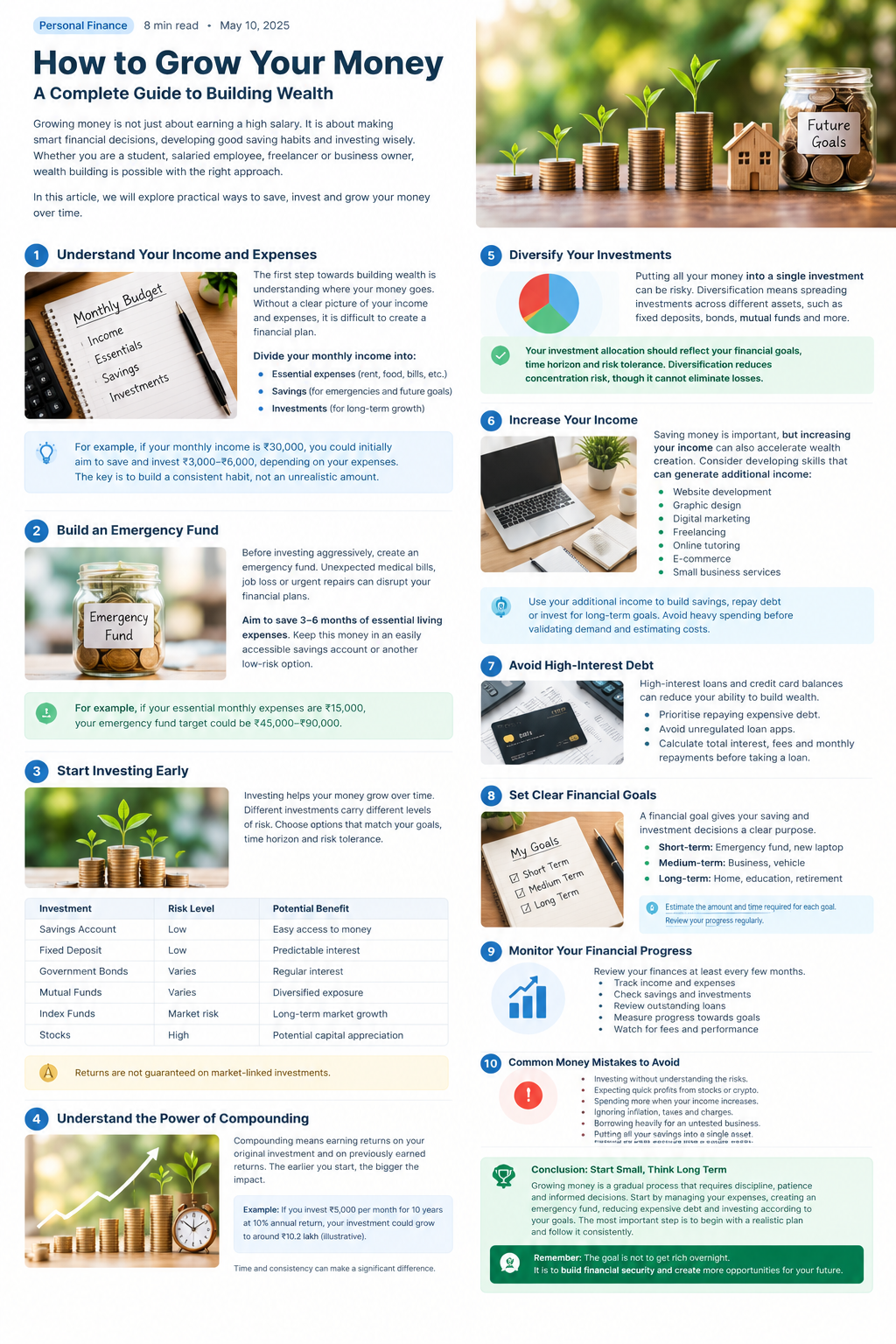
How to Grow Your Money: A Complete Guide to Building Wealth
Personal Finance • 8-minute read

Introduction: Make Your Money Work for You
Growing money is not just about earning a high salary. It is about making smart financial decisions, developing good saving habits and investing wisely. Whether you are a student, salaried employee, freelancer or business owner, building wealth is possible with the right approach.
Many people believe that becoming wealthy requires a large amount of money. In reality, you can start building wealth with small amounts, provided you are consistent and patient.
In this article, we will explore practical ways to save, invest and grow your money over time.
1. Understand Your Income and Expenses

The first step towards building wealth is understanding where your money goes. Without a clear picture of your income and expenses, it is difficult to create a financial plan.
Start by dividing your monthly income into three categories:
- Essential expenses: Rent, food, electricity, transportation and other necessities.
- Savings: Money set aside for emergencies and future goals.
- Investments: Money allocated to assets that may grow in value over time.
For example, if your monthly income is ₹30,000, you could initially aim to save and invest ₹3,000–₹6,000, depending on your expenses and financial obligations.
The key is to establish a consistent habit rather than trying to save an unrealistic amount.
2. Build an Emergency Fund

Before investing aggressively, create an emergency fund. Unexpected medical bills, job loss or urgent repairs can disrupt your financial plans.
Ideally, aim to save three to six months' worth of essential living expenses. Keep this money in an easily accessible savings account or another suitable low-risk, liquid option.
For example, if your essential monthly expenses are ₹15,000, your emergency fund target could be ₹45,000–₹90,000.
An emergency fund helps prevent you from selling long-term investments at an unfavourable time or relying on expensive loans.
3. Start Investing Early

Investing can help your money grow over time. However, different investments carry different levels of risk.
Some common investment options include:
|
Investment
|
Risk level
|
Potential benefit
|
| --- | --- | --- |
|
Savings account
|
Low
|
Easy access to money
|
|
Fixed deposit
|
Low
|
Predictable interest
|
|
Government bonds
|
Varies
|
Regular interest, depending on the bond
|
|
Mutual funds
|
Varies
|
Diversified market exposure
|
|
Index funds
|
Market risk
|
Long-term participation in market growth
|
|
Stocks
|
High
|
Potential capital appreciation
|
Choose investments based on your financial goals, investment horizon and ability to tolerate losses. Returns are not guaranteed on market-linked investments.
4. Understand the Power of Compounding

Compounding means earning returns on your original investment as well as on previously accumulated returns.
For example, suppose you invest ₹5,000 every month and earn an illustrative annual return of 10%, compounded monthly.
Monthly investment calculator
Monthly investment
₹5,000
Investment period
10 years
Illustrative annual return
10%
Total amount invested
₹6,00,000
Estimated investment value
₹10,24,225
Illustrative growth
₹4,24,225
This is a mathematical illustration, not a guaranteed return. Actual investment values may be lower, and taxes and inflation are not included.
The important lesson is that time and consistency can make a significant difference to your investment's value.
5. Diversify Your Investments
Putting all your money into a single investment can expose you to unnecessary risk.
Diversification means spreading investments across different assets, such as fixed deposits, bonds, equity mutual funds and other suitable investments.
For example, someone saving for a house in two years may need a different portfolio from someone investing for retirement in 25 years.
Your investment allocation should reflect your financial goals, time horizon and risk tolerance. Diversification reduces concentration risk, although it cannot eliminate investment losses.
6. Increase Your Income

Saving money is important, but increasing your income can also accelerate wealth creation.
Consider developing skills that can generate additional income, such as:
- Website development
- Graphic design
- Digital marketing
- Freelancing
- Online tutoring
- E-commerce
- Small business services
You can use some of your additional income to build savings, repay expensive debt or invest for long-term goals.
However, avoid spending heavily on a new business before validating its demand and estimating its costs.
7. Avoid High-Interest Debt
High-interest loans and credit card balances can significantly reduce your ability to build wealth.
Prioritise repaying expensive debt while making the minimum required payments on other loans. Avoid borrowing money to invest in volatile assets or using unregulated loan applications.
Before taking a loan, calculate the total interest, fees and monthly repayment obligations.
8. Set Clear Financial Goals

A financial goal gives your saving and investment decisions a clear purpose.
You can divide your goals into three categories:
- Short-term: Building an emergency fund or buying a laptop.
- Medium-term: Starting a business or purchasing a vehicle.
- Long-term: Buying a home, funding children's education or retirement.
Estimate the amount required and the time available for each goal. Review your progress regularly and adjust your contributions when your income or expenses change.
9. Monitor Your Financial Progress
Building wealth is an ongoing process. Review your finances at least once every few months.
Track the following:
- Monthly income and expenses
- Total savings and investments
- Outstanding loans
- Progress towards financial goals
- Investment fees and performance
Do not judge your financial progress solely by short-term market movements. Focus on whether your overall plan remains suitable for your goals.
10. Common Money Mistakes to Avoid
- Investing without understanding the risks.
- Expecting quick profits from stocks, cryptocurrency or speculative schemes.
- Spending more whenever your income increases.
- Ignoring inflation, taxes and investment charges.
- Borrowing heavily to fund an untested business.
- Putting all your savings into a single asset.
Avoiding these mistakes can help protect the money you work hard to earn.
Conclusion: Start Small, Think Long Term
Growing money is a gradual process that requires discipline, patience and informed decisions. You do not need to become wealthy overnight or invest a large amount from the beginning.
Start by managing your expenses, creating an emergency fund, reducing expensive debt and investing according to your financial goals. As your income grows, consider increasing your savings and investments.
The most important step is to begin with a realistic plan and follow it consistently. Wealth creation is not just about how much money you earn; it is also about how wisely you manage the money you have.
Remember: The goal is not to get rich overnight. It is to build financial security and create more opportunities for your future.