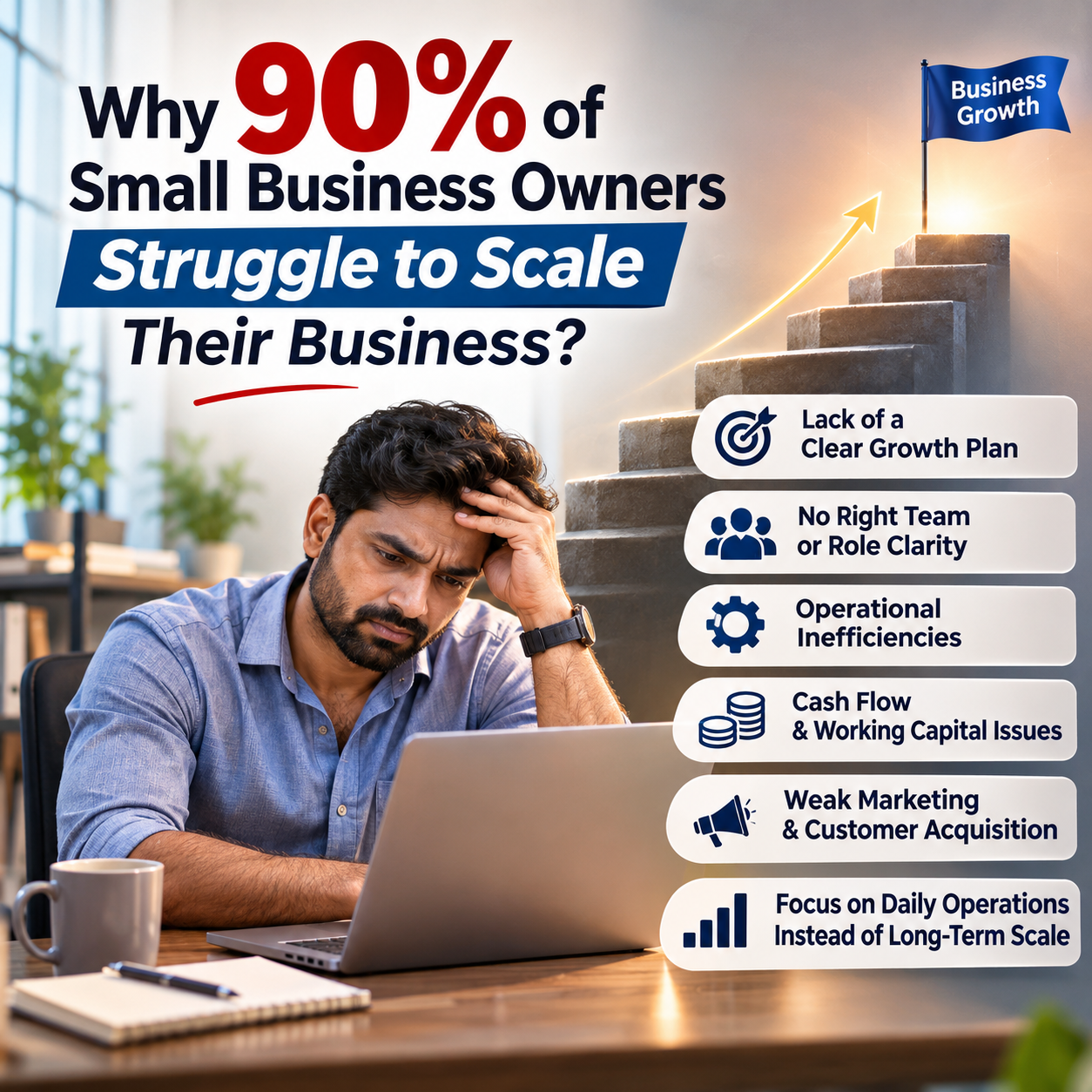
You started your business with a dream of becoming successful. You worked hard, acquired customers, generated revenue and built a team. But after a few years, you may still find yourself handling almost everything in the business.
Does this sound familiar?
You are busy throughout the day, attending meetings, handling customer complaints, managing employees, checking payments and looking after daily operations. Despite putting in long working hours, your business is not growing at the pace you expected.
Your revenue may have increased, but your profits have not improved significantly. Your team still depends on you for every important decision. You struggle to take time off because you know that several business activities may stop in your absence.
This is one of the biggest challenges faced by small business owners in India.
The problem is not always a lack of customers, capital or business opportunities. In many cases, the real problem is the absence of a structured business growth system.
Building a business and scaling a business are two different things.
Building a business requires entrepreneurial energy, hard work and determination. Scaling a business requires strategy, systems, people, financial discipline and leadership.
In this article, we will explore why many small business owners struggle to scale their businesses and what they can do to overcome these challenges.
1. Being Busy Is Not the Same as Growing Your Business
One of the most common mistakes entrepreneurs make is confusing business activity with business growth.
A typical business owner starts the day by checking WhatsApp messages, responding to customer enquiries, discussing pending orders, solving employee issues, following up on payments and attending meetings.
By the end of the day, the owner feels exhausted.
But ask an important question:
How much time did you actually spend working ON your business rather than working IN your business?
There is a significant difference between the two.
| Working IN the business | Working ON the business |
| Handling daily customer enquiries | Building a customer acquisition strategy |
| Checking every employee's work | Developing a performance management system |
| Personally following up on payments | Establishing a collection process |
| Solving daily operational problems | Eliminating the root causes of problems |
| Managing every sales opportunity | Building a structured sales team |
| Checking daily expenses | Developing financial plans and budgets |
When business owners spend almost all their time working IN the business, they have very little time left for planning its future.
Solution:
Start allocating dedicated time every week for strategic business activities.
Focus on:
- Reviewing business performance.
- Planning revenue growth.
- Identifying new business opportunities.
- Improving customer acquisition.
- Building team capabilities.
- Developing operational systems.
Your responsibility as a business owner should gradually shift from managing every activity to building an organisation that can manage those activities independently.
2. The Business Depends Too Much on the Owner
Imagine a business where:
- Every important customer wants to speak directly with the owner.
- Every purchase decision requires the owner's approval.
- Employees cannot solve even small problems independently.
- Sales stop when the owner is unavailable.
- No major decision is taken without the owner's involvement.
This is an owner-dependent business.
Such businesses can survive and generate revenue, but scaling becomes extremely difficult.
Why?
Because the owner's time, energy and decision-making capacity are limited.
If the business can handle only 20 customers because the owner personally manages everything, adding another 50 customers may create operational chaos.
Solution: Build a business that does not depend entirely on you.
Start by identifying activities that can be delegated to employees.
Create:
- Clearly defined job responsibilities.
- Approval and decision-making authority.
- Standard operating procedures.
- Reporting structures.
- Performance measurement systems.
Train your team to handle routine decisions independently.
Your objective should be to become the leader of the business rather than its biggest employee.
3. No Clear Business Growth Strategy
Many entrepreneurs operate their businesses without a clearly documented growth plan.
They want to increase revenue, acquire more customers and expand operations, but they have not defined how they will achieve these goals.
For example, a business owner may say:
"I want to grow my business from ₹1 crore to ₹5 crore."
But when asked how this growth will happen, there may be no clear answer.
- Which customer segment will generate additional revenue?
- Which products or services will contribute to growth?
- How many new customers are required?
- What sales team capacity is needed?
- How much working capital will be required?
- What operational changes are necessary?
Without answers to these questions, business growth becomes dependent on guesswork.
Solution: Create a structured business growth plan.
A practical growth plan should include:
- Current business performance.
- Revenue and profitability targets.
- Target customer segments.
- Product and service expansion opportunities.
- Sales and marketing strategy.
- Team and resource requirements.
- Financial projections.
- Monthly and quarterly milestones.
For example, if your current annual revenue is ₹1 crore and your target is ₹2 crore, you should break the target into monthly revenue goals and identify the additional customers, average order values and sales capacity required.
A growth target without an execution plan is only a wish.
4. Poor Financial Management and Lack of Cash Flow Planning
Revenue growth does not automatically mean financial growth.
Many businesses generate substantial sales but continue to struggle with cash availability.
Consider this example.
An Indian trading business generates ₹50 lakh in monthly sales.
Its approximate financial position is:
| Particulars | Amount |
| Monthly Sales | ₹50,00,000 |
| Cost of Goods Sold | ₹37,00,000 |
| Gross Profit | ₹13,00,000 |
| Operating Expenses | ₹9,00,000 |
| Operating Profit | ₹4,00,000 |
At first glance, the business appears profitable.
However, a significant portion of its sales may be on credit. Customers might take 45–60 days to make payments, while suppliers demand payment within 15–30 days.
The business can therefore experience a cash shortage despite reporting a profit.
This is why business owners must understand the difference between revenue, profit and cash flow.
Solution: Develop financial discipline.
Every business owner should regularly monitor:
- Profit and Loss Statement.
- Balance Sheet.
- Cash Flow Statement.
- Accounts Receivable.
- Accounts Payable.
- Inventory Position.
- Gross Profit Margin.
- Net Profit Margin.
- Working Capital Requirements.
Reviewing financial reports should become a regular management activity, not something done only during tax filing.
5. Lack of a Structured Sales and Marketing System
Many small businesses depend heavily on referrals, existing customers and occasional enquiries.
While referrals are valuable, relying on them as the only source of new business can make revenue unpredictable.
One month, the business may receive 50 enquiries and generate good sales. The next month, enquiries may suddenly decline.
Without a consistent sales and marketing system, it becomes difficult to forecast revenue.
A growing business needs a predictable customer acquisition process.
Solution: Build a structured sales and marketing funnel.
Your sales funnel should include:
Stage 1: Awareness
Make potential customers aware of your products and services through SEO, social media, advertising, networking and referrals.
Stage 2: Lead Generation
Capture enquiries through websites, landing pages, WhatsApp, phone calls and other channels.
Stage 3: Lead Qualification
Identify customers who have genuine requirements, purchasing capacity and buying intent.
Stage 4: Conversion
Use structured sales presentations, proposals, demonstrations and follow-ups to convert prospects.
Stage 5: Customer Retention
Provide excellent customer service, encourage repeat purchases and develop long-term relationships.
Track the performance of every stage.
For example:
| Sales Metric | Monthly Target |
| New Leads | 200 |
| Qualified Leads | 100 |
| Proposals Shared | 60 |
| New Customers | 20 |
| Average Deal Value | ₹25,000 |
| New Revenue | ₹5,00,000 |
These are illustrative targets. Actual numbers should be based on the business's industry, pricing and historical conversion rates.
The goal is to create a sales system that generates opportunities consistently rather than waiting for customers to arrive.
6. No Standard Operating Procedures (SOPs)
What happens when your most experienced employee leaves the organisation?
Does the next employee know exactly how to perform the same job?
If the answer is no, your business may have a process dependency problem.
Many small businesses operate based on individual experience rather than documented processes.
Employees know what to do because someone has taught them informally. But there is no written procedure explaining how the work should be performed.
This creates several problems:
- Inconsistent service quality.
- Repeated mistakes.
- Employee dependency.
- Difficulties in training new employees.
- Lack of accountability.
- Operational inefficiencies.
Solution: Document your business processes.
Create SOPs for important business functions.
| Department | Example SOPs |
| Sales | Lead handling, follow-ups, proposal preparation |
| Marketing | Campaign planning, content approval, reporting |
| Finance | Invoicing, payment collection, expense approval |
| HR | Recruitment, onboarding, attendance, leave |
| Operations | Order processing, quality checks, delivery |
| Customer Support | Complaint handling, escalation, resolution |
Start with the five most important repetitive processes in your business.
Document them, train employees and regularly review whether the procedures are being followed.
A business becomes easier to scale when important activities can be performed consistently, regardless of who performs them.
7. Wrong Hiring Decisions and Poor Team Management
Hiring more employees does not automatically increase business productivity.
Some businesses hire people without defining their responsibilities, performance expectations or reporting structures.
As a result, employees remain busy, but business owners struggle to measure their actual contribution.
Common team management problems include:
- Unclear job responsibilities.
- No measurable performance targets.
- Poor communication.
- Lack of employee training.
- No accountability.
- No performance review mechanism.
- Excessive dependence on the owner or manager.
Solution: Build a performance-driven organisation.
Every employee should understand:
- What work they are responsible for.
- What results they are expected to achieve.
- How their performance will be measured.
- Who they report to.
- How frequently their performance will be reviewed.
Introduce Key Result Areas (KRAs) and Key Performance Indicators (KPIs).
For example, a sales executive may have the following KPIs:
| KPI | Monthly Target |
| New Leads Contacted | 200 |
| Follow-ups Completed | 150 |
| Meetings Scheduled | 30 |
| New Customers Acquired | 10 |
| Revenue Generated | ₹5 lakh |
The numbers should be customised according to the business and sales cycle.
The purpose of performance management is not simply to monitor employees. It is to align individual performance with organisational goals.
8. Not Using Technology and Automation Effectively
In today's competitive environment, businesses cannot afford to depend entirely on manual processes.
Many business owners still manage customer information in spreadsheets, follow up with leads manually, prepare reports individually and coordinate employee tasks through scattered WhatsApp messages.
These practices may work at a smaller scale but become inefficient as the business grows.
Solution: Use technology to simplify business operations.
Some useful technology applications include:
| Business Function | Technology Application |
| Customer Management | CRM software |
| Sales Follow-ups | Automated reminders |
| Marketing | Marketing automation |
| Communication | WhatsApp Business integration |
| Accounting | Accounting software |
| Employee Management | HRMS and attendance systems |
| Task Management | Project management tools |
| Reporting | Business dashboards |
| Customer Support | Helpdesk software |
| Data Analysis | AI-powered analytics |
Artificial Intelligence and automation can also help businesses reduce repetitive work, improve customer response times and make better decisions.
However, technology should be implemented after understanding the business process. Automating a poorly designed process can simply make inefficiency happen faster.
9. No Performance Measurement System
Many business owners make important decisions based on assumptions.
They may believe that sales are improving, expenses are under control and employees are performing well.
But without reliable data, these assumptions can be misleading.
A growing business needs a performance measurement system.
Solution: Develop a monthly business dashboard.
Your dashboard should cover five major areas:
Business Performance Dashboard
Sales Performance
Revenue, leads, conversion rates
Financial Performance
Profit, cash flow, expenses
Team Performance
Productivity, targets, attendance
Operational Performance
Efficiency, quality, delivery
Customer Performance
Acquisition, satisfaction, retention and repeat business
Conduct a monthly review meeting to evaluate performance, identify gaps and assign corrective actions.
What gets measured can be managed more effectively.
10. The Owner Has Not Developed a Leadership Mindset
Perhaps the biggest obstacle to business growth is the mindset of the business owner.
In the early stages, entrepreneurs personally handle almost everything. This is often necessary to establish the business.
But as the business grows, the owner's role must evolve.
The skills that help you start a business are not necessarily the same skills that help you scale it.
A business owner must gradually develop the ability to:
- Think strategically.
- Make data-driven decisions.
- Build and lead teams.
- Delegate responsibilities.
- Manage financial resources.
- Develop business systems.
- Identify growth opportunities.
- Create a long-term vision.
Your business can only grow sustainably when your leadership capabilities grow with it.
11. A Practical 5-Step Framework to Scale Your Small Business
Understanding business problems is important, but taking action is even more important.
Here is a practical five-step framework that business owners can start implementing.
Step 1: Assess Your Current Business
Before planning growth, understand where your business stands today.
Evaluate:
- Current annual revenue.
- Gross and net profit margins.
- Customer base.
- Sales performance.
- Employee productivity.
- Operational efficiency.
- Cash flow position.
Identify the biggest gaps preventing your business from growing.
Step 2: Create a Clear Growth Plan
Define where you want your business to reach.
For example:
- Current annual revenue: ₹1 crore.
- Target annual revenue: ₹2 crore.
- Target timeline: 12–18 months.
Break the target into monthly milestones.
Identify the additional customers, resources, marketing activities and operational capacity required.
Step 3: Build Systems and Processes
Document important business processes.
Develop SOPs for sales, marketing, finance, HR and operations.
Use technology wherever it can reduce manual work and improve efficiency.
Step 4: Build a Strong Team and Delegate
Hire people based on business requirements.
Define roles and responsibilities.
Introduce KRAs, KPIs and regular performance reviews.
Transfer decision-making authority wherever appropriate.
Step 5: Monitor, Improve and Scale
Review your business dashboard regularly.
Measure actual performance against targets.
Identify bottlenecks and take corrective action.
Once your business processes become stable, gradually expand customer acquisition, products, services and operations.
Remember: Scaling should be supported by operational capacity and financial strength, not just increasing sales.
12. Are You Ready to Scale Your Business?
Take a moment to evaluate your business.
Answer these ten questions honestly.
Business Growth Readiness Assessment
0/10 answered
1. I have a clearly documented business growth plan.
YesNo
2. I regularly review my business financial reports.
YesNo
3. My business has a predictable sales and marketing system.
YesNo
4. My team can handle daily operations without my constant involvement.
YesNo
5. Important business processes are documented through SOPs.
YesNo
6. Every employee has clearly defined KRAs and KPIs.
YesNo
7. I have a system for tracking customer enquiries and follow-ups.
YesNo
8. I regularly monitor cash flow and working capital.
YesNo
9. I use technology and automation to improve productivity.
YesNo
10. I spend dedicated time working ON my business.
YesNo
Answer all ten questions to calculate your score.
This is a self-assessment tool, not a formal business valuation or audit. Use your answers to identify the areas that need attention first.
Conclusion: Stop Managing Everything. Start Building a Scalable Business.
Every entrepreneur starts a business with the hope of creating something successful.
But long-term business success is not just about generating more revenue. It is about building an organisation that can grow sustainably, serve customers consistently, generate healthy profits and operate through capable people and well-defined systems.
If your business depends entirely on you, your growth will always be limited by your personal capacity.
Start by improving your financial management, developing a structured sales process, documenting business operations, building a capable team and adopting the right technology.
Your goal should not be to become the busiest person in your business. Your goal should be to build a business that performs, grows and creates value even when you are not involved in every activity.
Growth begins when you stop doing everything yourself and start building systems that enable your business to grow.
Take the Next Step with CA Sukhvinder
Why SMEs Should Consider Hiring a Business Consultant Even on a Budget
Ready to Take Your Business to the Next Level?
Growing a business requires more than hard work. It requires the right strategy, financial clarity, structured systems and effective leadership.
CA Sukhvinder helps entrepreneurs and business owners understand their business challenges, identify growth opportunities and develop structured roadmaps for sustainable business growth.
Take the first step towards building a stronger, more profitable and scalable business.
Explore Wealth Smart Learning
13. Frequently Asked Questions (FAQs)
1. Why do small businesses struggle to grow?
Small businesses often struggle because of poor financial management, inconsistent sales, lack of business planning, owner dependency, weak team structures and undocumented processes.
2. How can I scale my small business in India?
Start by analysing your current business performance, setting clear growth targets, developing a predictable sales system, improving financial management, building a capable team and implementing standard operating procedures.
3. What is the biggest challenge in scaling a business?
One of the biggest challenges is moving from an owner-dependent business to a professionally managed organisation where employees, systems and processes support daily operations.
4. How important is financial planning for business growth?
Financial planning helps business owners manage cash flow, control expenses, maintain working capital, evaluate profitability and make informed expansion decisions.
5. How can I grow my business without increasing operational costs significantly?
Focus on improving employee productivity, automating repetitive activities, increasing customer retention, optimising existing resources and improving sales conversion rates.
6. What is the difference between business growth and business scaling?
Business growth generally involves increasing revenue, customers or resources. Business scaling focuses on increasing business output while managing the additional operational complexity and cost efficiently.
7. When should a business owner hire a professional business coach?
A business owner may benefit from professional coaching when facing challenges with growth strategy, financial management, team performance, delegation, operational systems or business expansion.